
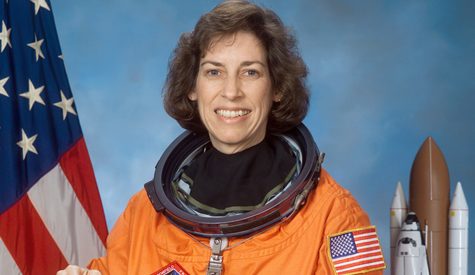

BIOGRAPHY
Ellen Ochoa is a pioneering figure in the fields of space exploration, engineering, and STEM leadership. As the first Hispanic woman to travel to space and the first Hispanic director of NASA’s Johnson Space Center, Ochoa has broken barriers and inspired countless individuals to pursue careers in science, technology, engineering, and mathematics (STEM). Her journey from a curious child with a passion for learning to a renowned astronaut and leader is a testament to her determination, intellect, and commitment to excellence.
Early Life and Formative Years
Ellen Ochoa was born on May 10, 1958, in Los Angeles, California, to Joseph and Rosanne Ochoa. Her father, Joseph, was of Mexican descent, and her mother, Rosanne, was of European ancestry. Ellen was the middle child in a family of five siblings. Her parents divorced when she was in high school, and her mother raised the children as a single parent. Despite the challenges of a single-parent household, Rosanne Ochoa instilled in her children the importance of education, hard work, and perseverance.
From an early age, Ellen exhibited a keen interest in learning and problem-solving. She excelled in school, particularly in mathematics and science, and was an avid reader. Her mother encouraged her curiosity and supported her academic pursuits, often taking her to the library and fostering a love of knowledge. Ellen also developed a passion for music, learning to play the flute and participating in her school’s band. This early exposure to both the arts and sciences would later shape her interdisciplinary approach to problem-solving.
Ellen attended Grossmont High School in La Mesa, California, where she graduated as valedictorian in 1975. Her academic achievements earned her a scholarship to San Diego State University, where she initially pursued a degree in music. However, after taking a physics class, she became fascinated with the subject and decided to switch her major to physics. This decision marked a turning point in her life, setting her on a path toward a career in science and engineering.
Education and Mentors
Ellen Ochoa’s educational journey was marked by academic excellence and a commitment to pushing the boundaries of her knowledge. After earning her Bachelor of Science degree in Physics from San Diego State University in 1980, she went on to pursue graduate studies at Stanford University. At Stanford, she earned a Master of Science degree in Electrical Engineering in 1981 and a Ph.D. in the same field in 1985. Her doctoral research focused on optical systems for information processing, a cutting-edge area of study at the time.
During her time at Stanford, Ochoa was mentored by several influential professors who encouraged her to pursue innovative research and explore new frontiers in engineering. One of her key mentors was Dr. Joseph Goodman, a renowned expert in optics and holography. Under his guidance, Ochoa developed expertise in optical systems and contributed to advancements in the field. Her research laid the groundwork for her later work at NASA, where she would apply her knowledge of optics to develop space-based imaging systems.
Ochoa’s graduate studies also exposed her to the broader scientific community and the possibilities of a career in space exploration. She attended conferences and collaborated with researchers from various disciplines, broadening her perspective and deepening her passion for science and engineering. These experiences solidified her desire to pursue a career that combined research, innovation, and exploration.
Early Career and Path to NASA
After completing her Ph.D., Ellen Ochoa began her professional career as a research engineer at Sandia National Laboratories in Livermore, California. At Sandia, she worked on optical systems for image processing and pattern recognition, further honing her expertise in the field. Her work at Sandia was highly regarded, and she quickly established herself as a talented and innovative engineer.
In 1987, Ochoa joined NASA’s Ames Research Center as a research scientist. At Ames, she led a team of engineers working on optical systems for space exploration. Her research focused on developing advanced imaging systems for use in space, including systems for autonomous spacecraft navigation and robotic vision. Her work at Ames was instrumental in advancing NASA’s capabilities in space-based imaging and laid the foundation for her future contributions to the agency.
During her time at Ames, Ochoa became increasingly interested in the possibility of becoming an astronaut. She was inspired by the achievements of the first female astronauts, such as Sally Ride, and saw an opportunity to combine her passion for science and engineering with her desire to explore new frontiers. In 1990, she applied to NASA’s astronaut training program and was selected as one of 23 candidates out of more than 2,000 applicants.
Becoming an Astronaut
Ellen Ochoa’s selection as an astronaut candidate marked the beginning of a new chapter in her career. She moved to Houston, Texas, to begin her training at NASA’s Johnson Space Center. The rigorous training program included instruction in space shuttle systems, robotics, spacewalks, and survival skills, as well as physical conditioning and flight training. Ochoa excelled in the program, demonstrating not only her technical expertise but also her ability to work effectively as part of a team.
In July 1991, Ochoa completed her training and was officially designated as an astronaut. She became the first Hispanic woman to be selected for NASA’s astronaut corps, a historic achievement that brought her widespread recognition and acclaim. Her selection was a source of pride for the Hispanic community and an inspiration to young women and girls across the country.
Space Missions and Contributions to Space Exploration
Ellen Ochoa’s first space mission took place in April 1993, when she served as a mission specialist aboard the Space Shuttle Discovery (STS-56). During the nine-day mission, Ochoa and her crewmates conducted a series of experiments to study the Earth’s atmosphere and the effects of solar radiation. Ochoa operated the shuttle’s robotic arm to deploy and retrieve a satellite, showcasing her expertise in robotics and space operations. Her performance on the mission earned her praise from her colleagues and further solidified her reputation as a skilled astronaut.
Ochoa went on to fly on three additional space missions, each of which contributed to advancements in space exploration and scientific research. In November 1994, she served as a mission specialist on the Space Shuttle Atlantis (STS-66), where she conducted experiments to study the Earth’s ozone layer. In May 1999, she flew on the Space Shuttle Discovery (STS-96) as part of the first shuttle mission to dock with the International Space Station (ISS). During the mission, Ochoa and her crewmates delivered supplies and equipment to the ISS, paving the way for future missions to the station.
Her final space mission took place in April 2002, when she served as payload commander on the Space Shuttle Atlantis (STS-110). During the mission, Ochoa and her crewmates installed a truss structure on the ISS, a critical component of the station’s framework. Ochoa’s leadership and technical expertise were instrumental in the success of the mission, which marked another milestone in the construction of the ISS.
Throughout her career as an astronaut, Ochoa logged nearly 1,000 hours in space and made significant contributions to NASA’s scientific and exploratory missions. Her achievements as an astronaut not only advanced our understanding of space but also inspired a new generation of scientists, engineers, and explorers.
Leadership at NASA
After her final space mission, Ellen Ochoa transitioned to leadership roles at NASA, where she continued to make an impact on the agency’s programs and initiatives. In 2007, she was appointed Deputy Director of NASA’s Johnson Space Center, where she oversaw the center’s operations and played a key role in shaping its strategic direction. In 2013, she became the first Hispanic director of the Johnson Space Center, a position she held until her retirement in 2018.
As director, Ochoa led the center through a period of significant change and innovation. She oversaw the development of new technologies and systems for human spaceflight, including the Orion spacecraft and the Space Launch System (SLS). She also played a key role in advancing NASA’s efforts to explore Mars and other destinations in the solar system. Under her leadership, the Johnson Space Center remained at the forefront of space exploration and continued to inspire the next generation of explorers.
Legacy and Impact
Ellen Ochoa’s contributions to space exploration and STEM leadership have left an indelible mark on the world. As the first Hispanic woman to travel to space and the first Hispanic director of the Johnson Space Center, she has broken barriers and paved the way for future generations of women and minorities in STEM fields. Her achievements have inspired countless individuals to pursue careers in science, technology, engineering, and mathematics, and her leadership has helped shape the future of space exploration.
In addition to her work at NASA, Ochoa has been a passionate advocate for STEM education and diversity in the sciences. She has served on numerous boards and committees dedicated to promoting STEM education and increasing opportunities for underrepresented groups. She has also been a sought-after speaker and mentor, sharing her experiences and insights with students, educators, and professionals around the world.
Ellen Ochoa’s legacy is one of excellence, innovation, and inspiration. Her journey from a curious child with a passion for learning to a trailblazing astronaut and leader is a testament to the power of determination, hard work, and a commitment to making a difference. As we look to the future of space exploration and STEM, Ellen Ochoa’s story serves as a reminder of the incredible possibilities that await those who dare to dream and strive for greatness.
Ellen Ochoa’s life and career are a testament to the transformative power of education, mentorship, and perseverance. Her groundbreaking achievements have not only advanced our understanding of space but also inspired a new generation of explorers and innovators. As we celebrate her contributions, we are reminded of the importance of fostering curiosity, embracing diversity, and pursuing excellence in all that we do. Ellen Ochoa’s legacy will continue to inspire and guide us as we reach for the stars.